
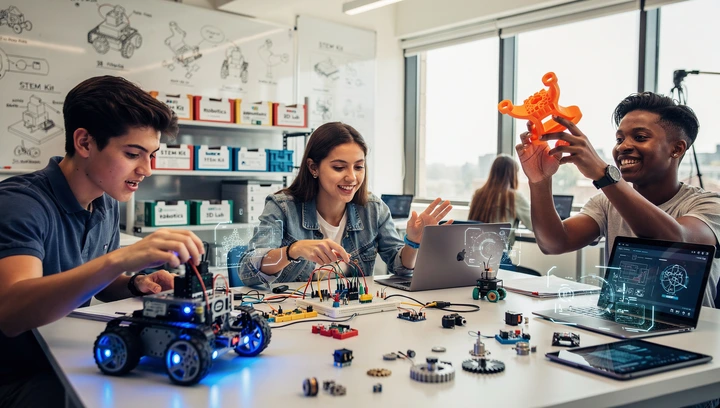
Hey future scientists, engineers, tech whizzes, and math gurus! 👋 Have you ever wondered how things work, or dreamed of building something amazing? Maybe you’ve seen a cool robot and thought, “I could make that!” Or perhaps you’re fascinated by renewable energy and want to figure out how to harness the sun’s power. If any of this sounds like you, then get ready, because we’re about to explore something truly exciting: STEM curriculum kits for high school!
These aren’t your average boring textbooks. Imagine learning about science, technology, engineering, and math (STEM) by actually doing it. That’s what these kits are all about! They bring learning to life, turning tricky topics into fun, hands-on adventures. We’ll dive into what makes these high school STEM kits so awesome, why they’re super important for your future, and how they help you build skills that will last a lifetime. So, let’s get building, experimenting, and discovering together!
Table of Contents
What’s the Big Deal with STEM? Understanding the Foundation 🍎
Before we jump into the cool kits, let’s quickly chat about what STEM actually means. STEM stands for:
- Science: This is all about understanding the world around us. Think biology (living things), chemistry (how stuff mixes), and physics (how things move and energy works).
- Technology: This isn’t just about computers and phones! It’s about using tools and inventions to solve problems. It could be anything from building a bridge to creating an app.
- Engineering: This is where you design and build things. Engineers use science and math to create everything from skyscrapers to spacecraft.
- Math: This is the language of STEM. It helps us measure, count, understand patterns, and solve problems using numbers.
Why is STEM such a big deal, especially for high school students? Well, the world is changing super fast! Many of the jobs of tomorrow will need people who are great at thinking, solving problems, and being creative – all skills you learn through STEM. Plus, understanding STEM helps you make sense of the world, from climate change to the latest gadgets.
Beyond the Classroom: Why Hands-On Learning Hits Different ✨
Think about it: would you rather read a book about riding a bike, or actually get on a bike and learn to balance? Most of us would pick riding the bike! That’s the magic of hands-on learning, especially with STEM curriculum kits for high school.
When you actively build, experiment, and troubleshoot, your brain learns in a different, deeper way. It’s not just memorizing facts; it’s understanding why things happen and how to make them happen. This kind of learning sticks with you much longer and makes subjects much more interesting. It’s like being a detective, a builder, and a scientist all at once!
The Power of Play: How High School STEM Kits Make Learning Fun 🥳
Remember playing with LEGOs or building forts when you were younger? That feeling of creating something with your own hands? STEM curriculum kits bring that same playful, creative energy into high school learning. They turn abstract concepts into tangible projects you can touch, see, and even sometimes hear!
For example, instead of just reading about circuits, you can actually wire up lights and motors to see electricity in action. Instead of just looking at formulas for bridges, you can build miniature bridges and test how much weight they can hold before they collapse. This active engagement makes learning feel less like work and more like an exciting challenge.
Diving Deep: What Kinds of STEM Kits Are Out There for High Schoolers? 🔬
The world of high school STEM kits is huge and exciting! There’s a kit for almost every interest, helping you explore different parts of science, technology, engineering, and math. Let’s look at some popular categories and what you might learn from them.
Robotics and Coding Kits: Building the Future, One Robot at a Time 🤖
These kits are incredibly popular and for good reason! They combine engineering (building the robot) with technology (programming it to move and do tasks).
- What you do: You’ll assemble robot parts, like motors, sensors, and wheels. Then, you’ll use coding languages (often visual block-based coding, or text-based like Python) to tell your robot what to do – move forward, turn, pick something up, or even draw!
- What you learn:
- Engineering Design: How to put mechanical parts together.
- Problem-Solving: If your robot doesn’t move right, you have to figure out why!
- Computational Thinking: Breaking down big problems into smaller steps for the robot.
- Coding Skills: Understanding logic, sequences, and commands.
- Examples: Many kits use platforms like Arduino or micro:bit, allowing you to build and program everything from simple bug bots to more complex automated systems. Companies like Studica and STEMpedia offer a range of robotics and AI lab solutions.
Electronics Kits: Unraveling the Mysteries of Circuits and Power ⚡
Ever wondered what makes your phone light up or your computer work? Electronics kits give you a peek inside!
- What you do: You’ll work with breadboards, wires, resistors, LEDs, and other electronic components to build circuits. You might create blinking lights, sound generators, or even simple alarms.
- What you learn:
- Electrical Principles: How electricity flows, voltage, current, and resistance.
- Circuit Design: How to connect components to achieve a desired function.
- Troubleshooting: Identifying why a circuit isn’t working.
- Safety: Understanding how to work safely with electricity.
- Examples: Kits can range from basic snap circuits to more advanced ones that introduce microcontrollers for more complex projects. Some kits, like those from Studica, focus on understanding specific concepts like control systems.
Renewable Energy Kits: Powering Up for a Greener Tomorrow ☀️🌬️
With growing concerns about our planet, understanding renewable energy is more important than ever. These kits let you explore sustainable power sources.
- What you do: You’ll build models that use solar panels, wind turbines, or even fuel cells to generate electricity. You might power small motors, charge batteries, or light up LEDs using only natural energy.
- What you learn:
- Physics of Energy: How solar, wind, and water power are converted into electricity.
- Environmental Science: The importance of sustainable energy.
- Engineering Efficiency: How to design systems that maximize energy capture.
- Measurement: Using multimeters to measure voltage and current.
- Examples: Studica offers a “STEM Renewable Energies” kit that explains generation, storage, and use of electricity from natural sources.
Engineering Design Challenges: Building Solutions to Real-World Problems 🌉
Engineering kits often present you with a problem and challenge you to design and build a solution.
- What you do: You might design and build a bridge that can hold the most weight, create a device to filter water, or engineer a vehicle that travels the farthest. The focus is on the design process itself.
- What you learn:
- Design Thinking: Identifying problems, brainstorming solutions, prototyping, testing, and refining.
- Material Science: Understanding the properties of different materials.
- Structural Integrity: How forces affect objects and structures.
- Collaboration: Often, these projects are done in teams, teaching you to work with others.
- Examples: Kits from Blu Track encourage students to design and test different track layouts, while Pitsco Education offers kits like “True Scale House Framing Kit” or “CO₂ Dragsters” for hands-on engineering projects.
3D Printing and Design Kits: Bringing Ideas to Life Digitally and Physically 🖨️
3D printing is a revolutionary technology, and these kits let you get in on the action!
- What you do: You’ll learn to use 3D design software (CAD) to create virtual objects. Then, if a 3D printer is available, you can print your designs into physical objects! You might design parts for other projects or create artistic pieces.
- What you learn:
- Computer-Aided Design (CAD): How to use software to create 3D models.
- Spatial Reasoning: Thinking about objects in three dimensions.
- Manufacturing Processes: Understanding how things are made layer by layer.
- Prototyping: Quickly creating physical models of your ideas.
- Examples: MyStemKits offers a vast library of ready-to-print 3D models and curriculum for 3D printing. Pitsco also has “3-D Printing: Vehicle Engineering and Design Solutions Package.”
Virtual STEM Kits: Learning Anywhere, Anytime 🌐
Sometimes, you can’t have physical parts. That’s where virtual kits come in!
- What you do: These kits use computer simulations to let you experiment and explore STEM concepts. You might launch virtual rockets, simulate weather patterns, or explore digital circuits.
- What you learn:
- Conceptual Understanding: Grasping complex ideas through interactive simulations.
- Data Analysis: Often, these simulations generate data you can analyze.
- Problem-Solving in a Virtual Environment: Testing hypotheses without physical constraints.
- Examples: MyStemKits provides virtual STEM kits that offer open-ended simulations, allowing students to engage with lessons even remotely.
What Skills Do High School STEM Kits Help You Build? 🏗️
It’s not just about building a robot or understanding a circuit; it’s about building you! STEM curriculum kits for high school are fantastic for developing a range of “soft skills” and “hard skills” that are super valuable in any career path.
Here’s a quick look at some of the amazing skills you’ll sharpen:
- Critical Thinking: 🤔 You’ll learn to look at problems from all angles, ask good questions, and evaluate different solutions.
- Problem-Solving: 💡 When something doesn’t work (and it will, that’s part of the fun!), you’ll figure out what went wrong and how to fix it.
- Creativity and Innovation: ✨ These kits encourage you to think outside the box, come up with new ideas, and design your own unique solutions.
- Collaboration and Teamwork: 🤝 Many projects are best done with a partner or a group, teaching you how to communicate, share ideas, and work together effectively.
- Communication Skills: 🗣️ You’ll learn to explain your ideas, describe your experiments, and present your findings clearly.
- Resilience and Patience: 💪 Not every experiment works on the first try! You’ll learn to keep trying, learn from mistakes, and not give up.
- Attention to Detail: 🔍 Following instructions, connecting wires correctly, or writing precise code requires careful attention.
- Data Analysis: 📊 Many experiments involve collecting data and figuring out what it means.
- Digital Literacy: 💻 You’ll become more comfortable with software, coding platforms, and digital tools.
These are skills that employers absolutely love! They show you’re not just smart, but also adaptable, a good communicator, and someone who can tackle challenges head-on.
What to Look for in a Great High School STEM Curriculum Kit 🎯
With so many options out there, how do you choose the right high school STEM kit? Here are some things to consider to make sure you get the best experience:
| Feature | What to Look For | Why It Matters |
| Clear Instructions | Easy-to-understand guides, step-by-step videos, or clear diagrams. | You don’t want to spend all your time trying to figure out what to do! |
| Curriculum Alignment | Does it connect to what you’re learning in school (e.g., Next Generation Science Standards – NGSS)? | Helps reinforce classroom learning and makes the kit more useful for teachers. |
| Durability of Parts | Components that can withstand repeated use and experimentation. | You want the kit to last for many projects and students. |
| Reusability/Adaptability | Can the parts be used for different projects? Can the kit be scaled for different skill levels? | Maximizes the value of the kit and allows for more creative freedom. |
| Safety Features | Appropriate safety warnings and design elements, especially for electrical or mechanical components. | Your safety is super important! |
| Teacher Resources | Lesson plans, answer keys, background info, assessment suggestions (if for a classroom setting). | Makes it easier for teachers to integrate the kit into their lessons. |
| Engagement Factor | Projects that are interesting, challenging, and provide a sense of accomplishment. | You want to be excited to open the kit and start building! |
| Support & Community | Access to online forums, customer support, or additional project ideas. | If you get stuck, it’s great to have help available. |
| Cost-Effectiveness | A good balance between price and the quality/quantity of learning experiences offered. | Especially important for schools or groups buying multiple kits. |
| Real-World Connections | Does the kit show how the concepts relate to actual jobs or applications? | Helps you see the relevance of what you’re learning and inspires future career paths. |
Getting Started: A Checklist for Picking Your Perfect STEM Adventure 🗺️
Ready to dive in? Here’s a little checklist to help you or your teacher choose the best STEM curriculum kits for high school:
- What are you most interested in? 🤔 Robotics, electronics, green energy, building? Start with what excites you!
- What skills do you want to develop? 🎯 Do you want to learn to code, design, or troubleshoot?
- Are you working alone or with a group? 🧑🤝🧑 Some kits are great for solo exploration, others are designed for teams.
- What’s your current skill level? 🤓 Some kits are for beginners, others are more advanced. Look for kits that challenge you but aren’t overwhelming.
- How much time do you have? ⏳ Some projects are quick, others might take weeks to complete.
By thinking about these questions, you can narrow down your choices and find a kit that’s just right for you.
Integrating STEM Kits: Bringing Hands-On Learning into Classrooms and Beyond 🏫
High school STEM curriculum kits aren’t just for after-school fun; they’re becoming a vital part of classroom learning! Teachers use these kits to:
- Make abstract concepts concrete: It’s easier to understand physics principles when you can build a roller coaster and see them in action.
- Foster inquiry-based learning: Instead of just being told answers, students are encouraged to ask “what if?” and discover answers through experimentation.
- Prepare students for future careers: Many kits mimic real-world engineering or scientific processes, giving students a taste of what professional life in STEM fields is like.
- Encourage collaboration: Group projects with these kits teach essential teamwork skills.
- Differentiate instruction: Kits can often be adapted to suit different learning styles and paces.
Many companies, like Boxlight (with MyStemKits) and Studica, offer comprehensive bundles that include not only the physical components but also detailed lesson plans, teacher guides, student handouts, and assessment tools, making it easy for educators to integrate them. Blu Track kits also provide teacher resources with free STEM teaching materials, including lesson plans and data collection sheets.
Real-World Wonders: Where STEM Kit Skills Shine Brightest ✨
The skills you gain from these high school STEM kits aren’t just for school; they are in high demand in the real world! Let’s look at some examples:
- Building a self-driving car? You’ll need robotics, coding, and engineering design skills learned from your kits.
- Designing a new smartphone? Electronics and computational thinking will be key.
- Developing sustainable energy solutions for cities? Your renewable energy kit experiences will give you a head start.
- Creating amazing animations or video games? The logic and problem-solving from coding kits are super relevant.
- Becoming an architect or civil engineer? Understanding structures and materials from engineering design kits is foundational.
These kits are like mini-training grounds for future innovators. They help you explore different fields and discover what you’re passionate about, guiding you towards exciting career paths you might not have even known existed!
Beyond the Box: The Ecosystem of STEM Learning Tools 🌳
While STEM curriculum kits are fantastic, it’s worth remembering they often fit into a larger world of learning tools.
- Software and Apps: Many kits come with companion apps or require specific software for coding or design. Learning to navigate these digital tools is another valuable skill.
- Online Resources: There are countless tutorials, forums, and communities online where you can find extra help, new project ideas, and connect with other STEM enthusiasts.
- Virtual Reality (VR) and Augmented Reality (AR): Some advanced STEM learning is starting to use VR/AR to create immersive experiences, letting you “step inside” a molecule or “build” a complex machine virtually.
- Portable STEM Labs: Products like the Labdisc portable sensors mentioned by MyStemKits allow students to collect data and conduct experiments anywhere, turning any location into a science lab.
Exploring the Future: What’s Next for High School STEM Kits? 🔭
The world of STEM curriculum kits for high school is always growing and getting more exciting! What can we expect to see in the coming years?
- More AI and Machine Learning: Imagine kits where you teach a robot to learn from its mistakes or recognize objects! As AI becomes more common, expect to see more beginner-friendly AI projects integrated into kits. STEMpedia, for example, already offers “AI Packages for Schools” and kits focused on AI and robotics.
- Advanced Materials: Kits might include new types of smart materials that change shape or color, or even biodegradable plastics for more eco-friendly projects.
- Interdisciplinary Blends: Expect more kits that combine different STEM areas in creative ways. For instance, a kit that merges biology with robotics to create bio-inspired designs.
- Personalized Learning Paths: With technology, kits might be able to adapt to your learning pace and suggest projects based on your interests and progress.
- Enhanced Virtual and Augmented Reality: As these technologies become more accessible, virtual STEM kits could offer even more realistic and interactive simulations, bridging the gap between digital and physical experimentation.
- Gamified Learning: More kits will likely incorporate elements of games, like challenges, levels, and rewards, to make learning even more engaging and motivating.
The goal is always to make learning more engaging, accessible, and relevant to the real world. These advancements mean that the future of hands-on STEM education is incredibly bright for high school students like you!
Putting it All Together: Your Path to a Brighter Future 🌟
So, there you have it! STEM curriculum kits for high school are so much more than just a box of parts. They are gateways to discovery, tools for building incredible skills, and pathways to exciting futures. Whether you dream of building the next great invention, solving critical global challenges, or simply understanding the world better, these kits can give you a powerful head start.
They empower you to move beyond simply reading about concepts to actively experimenting, designing, and problem-solving. This hands-on approach sparks curiosity, builds confidence, and equips you with the critical thinking and creative skills that are essential for success in high school, college, and any career you choose. So, grab a kit, get ready to explore, and let your inner innovator shine! Who knows what amazing things you’ll build and discover? Happy experimenting! 🚀