
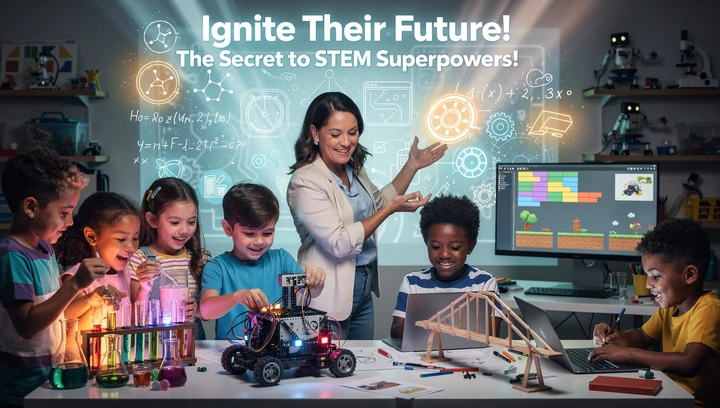
Hey there, future scientists, engineers, tech whizzes, and math masters! Ever wonder how your favorite science experiment came to be, or how that amazing robot in your class works? Or maybe you’ve been puzzled by a tough math problem, but then a teacher made it all click? Well, behind every “Aha!” moment in science, technology, engineering, and math (what we call STEM) is often a fantastic teacher. These educators are like superheroes, and just like superheroes need special training, so do our STEM teachers!
But what exactly is “STEM teacher training”? Think of it like a special school for teachers, designed to make them even better at teaching subjects like biology, chemistry, physics, computer coding, building things, and all sorts of math. It’s about giving them the tools, tricks, and confidence to inspire you, make learning exciting, and help you understand how these amazing subjects connect to the real world.
In this big article, we’re going to explore why this training is super important, what it looks like, and how it helps shape the incredible minds of tomorrow – maybe even yours! We’ll talk about everything from learning new teaching methods to understanding the latest gadgets, and even how teachers keep up with a world that’s always changing. So, let’s dive into the fascinating world of STEM teacher training!
Table of Contents
What’s the Big Deal with STEM Anyway? 🤔
Before we talk about training teachers, let’s quickly remember why STEM is such a huge deal. STEM stands for Science, Technology, Engineering, and Math. These aren’t just school subjects; they’re like the building blocks of our modern world!
- Science helps us understand how the world works, from tiny atoms to giant galaxies. It’s about asking “why?” and finding answers.
- Technology is all about creating tools and systems to solve problems. Think computers, smartphones, and even new ways to grow food.
- Engineering is like applied science and math. It’s about designing and building things, like bridges, robots, and even cool apps.
- Math is the language of the universe! It helps us measure, calculate, and understand patterns, which is essential for all other STEM fields.
Together, these fields drive innovation, help us solve big problems like climate change and disease, and create cool new jobs. That’s why having great STEM teachers who can spark your interest early is so incredibly important. They’re not just teaching facts; they’re helping you develop skills like problem-solving, critical thinking, and creativity that you’ll use your whole life!
Building Super Educators: The Core Ideas Behind STEM Teacher Training 🛠️
So, how do we turn a great person into a superhero STEM teacher? It all starts with training that focuses on a few key ideas. It’s not just about knowing a lot about science or math; it’s about knowing how to teach it in a way that makes sense and is exciting for students like you.
Here are some of the big ideas:
- Deep Subject Knowledge: First things first, teachers need to really know their stuff! This means not just remembering facts but understanding the “why” behind them. Training helps them go deeper into complex topics like quantum physics or advanced algebra so they can answer all your curious questions.
- Awesome Teaching Tricks (Pedagogy): This is where the magic happens! Training teaches teachers different ways to explain things. Do you learn best by listening? By doing? By seeing pictures? Great teachers know how to use all sorts of methods to reach every student. They learn about hands-on activities, group projects, and how to make lessons interactive.
- Connecting STEM to Real Life: Have you ever asked, “When will I ever use this?” Good STEM training shows teachers how to answer that question by linking what you learn in class to real-world jobs, inventions, and problems. This makes learning much more meaningful!
- Using Cool Tools (Technology Integration): Our world is full of amazing technology. Training helps teachers learn how to use things like smart boards, educational apps, coding platforms, and even virtual reality to make learning more engaging and effective.
- Making Learning Fun (Engagement Strategies): No one wants a boring class! Teachers learn how to create fun challenges, design exciting experiments, and tell captivating stories that make you want to learn more.
- Helping Every Student Succeed (Inclusivity): Every student is different, and that’s wonderful! Training helps teachers learn how to support all kinds of learners, including those who might struggle or those who are super-fast, making sure everyone feels included and can succeed in STEM.
It’s a big job, right? But with the right training, teachers can become amazing guides on your journey of discovery!
The Journey to Becoming a STEM Teaching Pro: Different Training Paths 🗺️
Just like there are different paths to becoming a scientist or an engineer, there are different ways teachers get their STEM superpowers. Some get their training before they even start teaching, while others keep learning throughout their careers.
Let’s look at some common paths:
1. University Degrees: The Foundation Stones
Most STEM teachers start their journey at a university or college. Here, they usually do two important things at the same time:
- Learn their Subject: They study science, math, or engineering in great detail, just like future scientists or engineers. This gives them a strong foundation in their chosen STEM field.
- Learn How to Teach (Education Degree): Alongside their STEM subjects, they take classes on “education.” These classes teach them about how kids learn, how to manage a classroom, how to create lesson plans, and all those “awesome teaching tricks” we talked about earlier.
Often, these programs include something called “student teaching” or “internships.” This is where future teachers get to practice teaching in real classrooms, with real students, under the guidance of experienced teachers. It’s like a superhero in training getting to fly around with a seasoned hero!
2. Specialized Programs: Fast Tracks and Deep Dives
Sometimes, someone who is already a scientist or engineer decides they want to become a teacher. That’s fantastic! There are special programs designed just for them. These programs often focus on giving them the teaching skills they need since they already have the deep subject knowledge. They might be shorter, more intense programs that get them ready for the classroom quickly.
There are also programs that focus specifically on how to teach STEM in new and exciting ways, like emphasizing hands-on learning, coding, or robotics. These are often called “STEM Education” programs.
3. Ongoing Learning (Professional Development): Never Stop Growing! 🌱
Even after teachers start their careers, their learning journey never truly ends. Think about it: science is always discovering new things, technology is always changing, and we’re always learning better ways to teach. That’s why “professional development” is so important.
Professional development means teachers regularly attend workshops, seminars, and conferences. They might learn about:
- New scientific discoveries to bring fresh examples into the classroom.
- Exciting new technologies like 3D printing or AI tools they can use with students.
- Better teaching strategies to help students who learn in different ways.
- How to create projects that combine science, technology, engineering, and math all at once (called “integrated STEM”).
These ongoing training sessions help teachers stay sharp, bring the latest knowledge to your classroom, and keep their lessons exciting and relevant. It’s like getting regular upgrades for their superhero powers!
Comparing Training Paths: A Quick Look
Here’s a simple table to show you some differences between initial university training and ongoing professional development:
| Feature | University Degree Programs (Initial Training) | Professional Development (Ongoing Training) |
| When it happens | Before becoming a certified teacher | Throughout a teacher’s career, after they are certified |
| Main Goal | To provide foundational subject knowledge and core teaching skills | To update skills, learn new methods, and specialize in areas |
| Content Focus | Broad understanding of subject matter, classroom management, lesson planning | Specific new technologies, innovative teaching strategies, current research |
| Duration | Multiple years (e.g., 4-year bachelor’s, 1-2 year master’s) | Short workshops (hours/days), courses (weeks), conferences (days) |
| Examples | Bachelor of Science in Math Education, Master of Arts in Teaching (Physics) | Workshop on coding for kids, Conference on space science, Robotics training |
The Secret Ingredients: What Makes Great STEM Training Stick? ✨
It’s not enough to just attend training; the training itself needs to be good! What are some of the “secret ingredients” that make STEM teacher training truly effective?
- Hands-On Learning for Teachers Too! 🖐️
If teachers are going to lead exciting experiments and projects in your class, they need to do them themselves first! Great training involves teachers actively doing science, building prototypes, and coding programs, not just listening to someone talk about it. This helps them understand the challenges and joys of discovery. - Connecting Theory to Practice 🔄
Teachers learn about different teaching methods (the “theory”). But then, the training helps them figure out how to use those methods in their actual classrooms with their specific students (the “practice”). This often involves observing other great teachers or practicing new techniques and getting feedback. - Working Together (Collaboration) 🤝
Teachers learn a lot from each other! Good training programs encourage teachers to work together, share ideas, and solve problems as a team. This builds a community of learning where everyone grows stronger. Imagine a group of superheroes sharing their best moves! - Long-Term Support 💪
Learning something new takes time and practice. The best training doesn’t just happen for a day and then disappear. It offers ongoing support, like mentors who can help teachers when they have questions, or follow-up sessions to check on their progress and offer more tips. - Focus on Student Thinking 🤔
A truly effective STEM teacher isn’t just focused on whether students get the “right” answer. They’re also interested in how students think, what their ideas are, and where they might be getting stuck. Training helps teachers develop ways to understand and guide student thinking, helping you build a deeper understanding rather than just memorizing.
These ingredients help ensure that when teachers leave a training program, they’re not just excited, but they also have the confidence and skills to make a real difference in your classroom.
Bringing STEM to Life: Exciting Teaching Methods Teachers Learn 🎨
One of the coolest things about STEM teacher training is that it introduces educators to fresh, exciting ways to teach. Gone are the days of just memorizing facts from a dusty textbook! Here are a few methods teachers learn to make STEM subjects sparkle:
1. Project-Based Learning (PBL) 🏗️
Imagine you’re asked to design a tiny house that runs on solar power, or build a robot that can sort recycling. That’s Project-Based Learning!
- What it is: Instead of learning facts and then doing a project, with PBL, you start with a real-world problem or challenge. You then learn the science, technology, engineering, and math needed to solve that problem as you go along.
- Teacher’s role: Teachers learn how to design these big projects, guide students through the process, help them find resources, and ask questions that make them think deeply.
- Why it’s awesome: It makes learning super relevant, helps you develop problem-solving skills, and encourages teamwork. Teachers learn how to let you lead the discovery!
2. Inquiry-Based Learning 🔍
Ever wondered why leaves change color in the fall? With inquiry-based learning, your teacher wouldn’t just tell you the answer. They’d help you design experiments to figure it out yourself!
- What it is: It’s all about asking questions and investigating to find answers. Teachers set up situations where students get curious and then guide them to explore, experiment, and draw their own conclusions.
- Teacher’s role: Training helps teachers craft good questions, set up safe and interesting investigation stations, and teach students how to think like scientists (observing, hypothesizing, testing).
- Why it’s awesome: You become a detective, actively discovering knowledge instead of just being told it. It builds critical thinking and curiosity!
3. Computational Thinking & Coding 💻
In today’s world, understanding how computers “think” is a superpower. Teachers learn how to introduce you to computational thinking even without a computer!
- What it is: It’s about breaking down big problems into smaller steps, recognizing patterns, creating step-by-step instructions (algorithms), and identifying key information. It’s the way computer scientists solve problems.
- Teacher’s role: Training covers how to teach basic coding (like Scratch or Python), how to use “unplugged” activities (coding without computers!), and how to connect computational thinking to science and math problems.
- Why it’s awesome: It teaches you powerful problem-solving strategies that are useful in every part of life, not just coding.
4. Integrating STEM: Breaking Down the Walls Between Subjects 🌉
Often, science, technology, engineering, and math are taught as separate subjects. But in the real world, they’re all connected!
- What it is: Integrated STEM means teachers design lessons where you use knowledge and skills from all four areas together to solve a problem. For example, you might use math to calculate the strength of a bridge design (engineering), then use technology to model it on a computer, and science to understand the materials.
- Teacher’s role: Training helps teachers see these connections and design interdisciplinary lessons and projects that blend the subjects naturally.
- Why it’s awesome: It shows you how STEM fields work together, making learning more holistic and preparing you for real-world challenges where you can’t just pick one subject to solve a problem.
These teaching methods, learned through effective STEM teacher training, are designed to make your classroom experience dynamic, engaging, and deeply meaningful.
The Tools of the Trade: How Teachers Learn to Use New Tech 🤖
Technology is always changing, and so are the tools available for learning. Great STEM teacher training keeps educators up-to-date with the latest gadgets, software, and platforms that can transform your classroom.
Here’s a peek at some technologies teachers learn to master:
- Interactive Whiteboards and Displays: These are like giant tablets where teachers can draw, write, show videos, and interact with digital content. Training helps teachers use these effectively to make lessons more dynamic and collaborative.
- Educational Apps and Software: From math games to virtual lab simulations, there are thousands of apps. Teachers learn which ones are best for different subjects and age groups, and how to use them to personalize learning or make complex ideas easier to grasp.
- Coding Platforms (e.g., Scratch, Python): As we mentioned, coding is a big deal. Teachers get hands-on training with visual coding languages like Scratch (great for beginners!) and text-based languages like Python, so they can teach you the basics of programming.
- Robotics Kits and Makerspaces: Ever built a robot or designed something with a 3D printer? Teachers learn how to use these tools safely and effectively, creating “makerspaces” in classrooms where you can design, build, and experiment with real-world prototypes.
- Virtual Reality (VR) and Augmented Reality (AR): Imagine exploring the human heart in 3D right in your classroom, or walking on Mars without leaving your seat! Teachers are learning how to use VR headsets and AR apps to create incredibly immersive learning experiences.
- Data Analysis Tools: With so much information available, understanding data is key. Teachers learn how to use simple tools to help students collect, organize, and interpret data from experiments or real-world sources, often using spreadsheets or simple graphing software.
The goal is not just to use technology for the sake of it, but to use it in ways that make learning more engaging, accessible, and powerful. Teachers learn to be digital navigators, guiding you through the exciting world of educational tech!
Why is This Training So Important for You? 🌟
You might be thinking, “This is all about teachers, but how does it affect me?” The answer is: a lot! Effective STEM teacher training has a huge positive impact on every student.
Here’s how:
- More Engaging Lessons: When teachers have fresh ideas and new tools, their lessons become more exciting. This means more hands-on activities, more cool experiments, and more chances for you to be actively involved in learning. Say goodbye to boring lectures!
- Deeper Understanding: Teachers trained in advanced methods can explain complex ideas in simpler, more relatable ways. They know how to help you really get a concept, not just memorize it for a test. This builds a stronger foundation for future learning.
- Better Problem-Solving Skills: With teachers who emphasize project-based and inquiry-based learning, you’ll get more opportunities to tackle real problems, think critically, and come up with creative solutions. These are skills you’ll use in every aspect of your life.
- Preparation for the Future: The jobs of tomorrow will heavily rely on STEM skills. Teachers who stay updated through training are better equipped to prepare you for these future roles, whether it’s in AI, renewable energy, or space exploration.
- Inspiration and Confidence: A great STEM teacher can ignite a spark in you, making you realize that you can do science, technology, engineering, or math. They build your confidence and show you that these subjects aren’t just for “brainy” people, but for anyone who is curious and willing to learn.
- Learning That Sticks: When learning is fun and meaningful, you’re more likely to remember it. Teachers who apply their training create experiences that leave a lasting impression, making learning enjoyable and memorable.
So, when teachers are getting good training, it means a better, more exciting, and more effective learning experience for every student in their classroom. It helps you discover your potential and get ready for an amazing future!
Challenges and Bumps in the Road: What Makes Training Tough? 🚧
Even superheroes face challenges! While STEM teacher training is incredibly important, there are some difficulties that can make it tricky to provide the best training to every teacher.
- Time, Time, Time! ⏳
Teachers are super busy! They have lessons to plan, papers to grade, and students to help. Finding extra time to attend long training sessions can be really hard. Sometimes, they have to use their evenings, weekends, or even summer break. - Keeping Up with Everything New: Imagine trying to learn about every new app, every new scientific discovery, and every new teaching method all at once! The world of STEM changes so fast that it’s a huge challenge for trainers to cover everything and for teachers to absorb it all.
- Cost of Training: Good training programs, especially those with cool tech or expert instructors, can be expensive. Schools and districts sometimes struggle to find enough money to send all their teachers to the best training.
- Making it Relevant for Every Teacher: A teacher who teaches 1st-grade science has different needs than a high school physics teacher. Creating training that is useful and relevant for everyone can be tricky.
- Getting All Teachers Involved: Not everyone loves trying new things, and some teachers might feel overwhelmed by new technologies or teaching methods. Encouraging all teachers to participate and embrace new ideas is a continuous effort.
- Lack of Follow-Up Support: Sometimes teachers attend a great workshop, get excited, but then don’t have enough support or resources back in their classrooms to actually use what they learned. It’s like learning a new skill but never getting to practice it.
These challenges highlight why ongoing support, smart planning, and enough funding are crucial to making STEM teacher training successful and widespread.
Looking Ahead: The Future of STEM Teacher Training 🚀
What’s next for STEM teacher training? Just like STEM fields themselves, the way we train teachers is always evolving. Here are some exciting things we might see more of in the future:
- Personalized Training Paths: Imagine training that’s perfectly tailored to what each teacher needs, rather than a one-size-fits-all approach. Teachers might have digital platforms where they can pick and choose modules on topics like AI in the classroom, advanced robotics, or new ways to teach climate science, all at their own pace.
- Virtual Reality (VR) for Practice: Teachers might put on VR headsets and practice teaching in a virtual classroom with AI-powered student avatars! This would allow them to try out new strategies and get feedback in a safe, low-stress environment before trying it with real students.
- More Focus on Interdisciplinary Learning: Expect even more training on how to seamlessly blend science, technology, engineering, and math. Teachers will learn how to design even more integrated projects that mirror real-world problem-solving.
- AI as a Teaching Partner: Teachers will learn how to use Artificial Intelligence (AI) tools not just as something to teach about, but also as a helper in their classrooms. AI could help grade papers, create personalized practice problems for students, or even suggest lesson ideas.
- Stronger Industry Connections: Training programs might connect teachers directly with scientists, engineers, and tech professionals from local companies. This would allow teachers to see real-world applications of STEM firsthand and bring those experiences back to their classrooms.
- Emphasis on “Soft Skills”: Beyond just subject knowledge, training will increasingly focus on teaching teachers how to foster important skills in students like creativity, teamwork, communication, and resilience. These are crucial for any future career.
The future of STEM teacher training is all about preparing teachers for a world that’s constantly innovating. It’s about equipping them to not just teach facts, but to inspire critical thinkers, creative problem-solvers, and future innovators – maybe even you!
Becoming a STEM Superhero: Supporting Our Teachers 🤝
We’ve talked a lot about what STEM teacher training is and why it’s so important. From learning deep subject knowledge to mastering new technologies and engaging teaching methods, it’s clear that preparing and supporting our STEM teachers is a big job. They are truly the superheroes of our classrooms, sparking curiosity, building confidence, and laying the groundwork for the next generation of discoverers and inventors.
The success of a nation, its ability to innovate, and its capacity to solve big global challenges often starts in the classroom with a passionate and well-trained STEM teacher. By investing in robust, ongoing STEM teacher training, we’re not just supporting educators; we’re investing in the bright future of every student. We’re empowering you to ask the big questions, dream up new solutions, and ultimately, shape the world around you. So, let’s appreciate and support these amazing teachers who help us all unlock our inner scientists, engineers, tech enthusiasts, and mathematicians!
To delve deeper into the importance of STEM education and the role of educators, you can explore resources like those provided by the National Science Teaching Association (NSTA). Their official website offers a wealth of information and insights into best practices for science education, which often intertwines with broader STEM principles. You can find out more by visiting the National Science Teaching Association.